The Spread Is a Fee Too.
Every share has two prices. The gap is a cost that is not on your bill.
Two Prices, at every moment of the day.
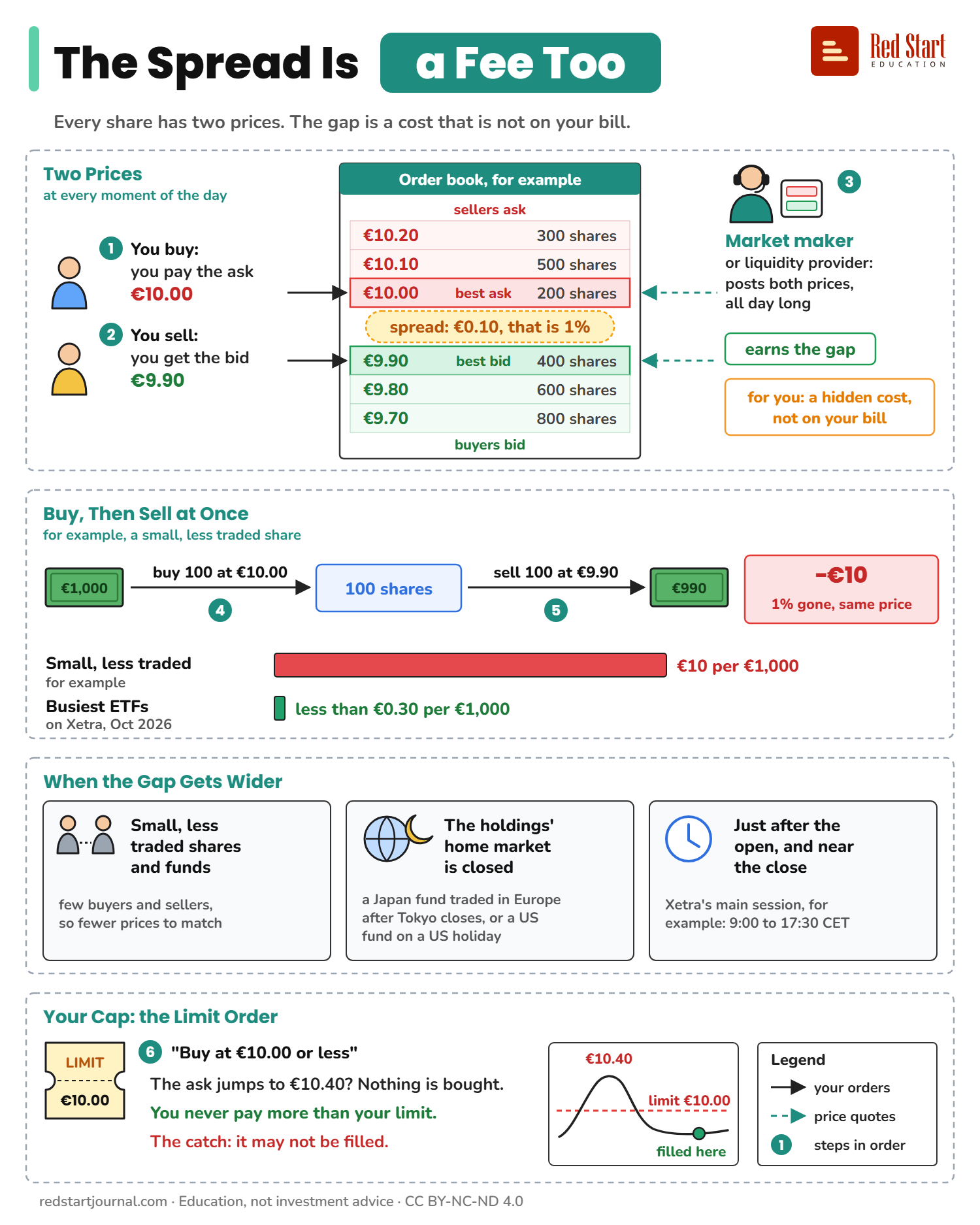
Order book, for example. Sellers ask: $10.20, 300 shares. $10.10, 500 shares. $10, 200 shares, the best ask.
Spread: $0.10, that is 1%.
Buyers bid: $9.90, 400 shares, the best bid. $9.80, 600 shares. $9.70, 800 shares.
- You buy: you pay the ask, $10.
- You sell: you get the bid, $9.90.
- Market maker, or liquidity provider: posts both prices, all day long. Earns the gap. For you: a hidden cost, not on your bill.
Buy, Then Sell at Once. For example, a small, less traded share.
$1,000.
- Buy 100 at $10. 100 shares.
- Sell 100 at $9.90. $990.
Minus $10: 1% gone, same price.
Small, less traded, for example: $10 per $1,000.
Busiest ETFs on Xetra, October 2026: less than $0.30 per $1,000.
When the Gap Gets Wider.
Small, less traded shares and funds: few buyers and sellers, so fewer prices to match.
The holdings' home market is closed: a Japan fund traded outside Japan after Tokyo closes, or a US fund on a US holiday.
Just after the open, and near the close. Xetra's main session, for example: 9:00 to 17:30 CET.
Your Cap: the Limit Order.
- "Buy at $10 or less."
The ask jumps to $10.40? Nothing is bought.
You never pay more than your limit.
The catch: it may not be filled.
Chart: the price rises to $10.40 above your limit of $10, then falls back; filled here.
Legend: your orders; price quotes; steps in order.
redstartjournal.com · Education, not investment advice · CC BY-NC-ND 4.0